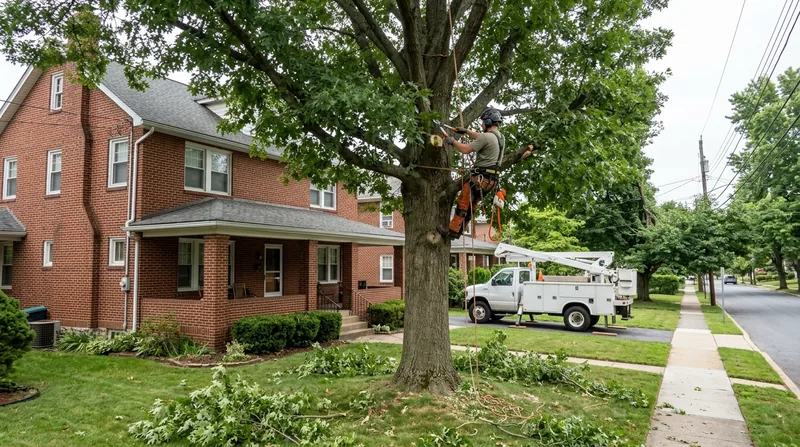




Tree Trimming & Pruning in Allentown keeps the maples, oaks, and sycamores that line the West End's deep-porched brick twins and Center City's Victorian rowhouses healthy, structurally sound, and off your roof and driveway. The Lehigh Valley's nor'easters, ice storms, and summer thunderstorms load branches with water and wind stress, and overhead utility lines along rear alleys create constant trimming pressure. Allentown's dense urban canopy, mixed with Norway spruce, London plane, and invasive tree-of-heaven in older neighborhoods, demands professional pruning that removes deadwood, thins crowns, and reduces storm damage without compromising tree vigor. We work on residential properties across Allentown, Bethlehem, Whitehall, and surrounding townships, handling everything from routine maintenance to emergency branch removal after severe weather. Proper pruning improves air circulation, sunlight penetration, and curb appeal while protecting your home and property lines.
Why Tree Trimming & Pruning Matters in Allentown's Storm-Prone Climate
Allentown's position in the Lehigh Valley puts it in the path of heavy nor'easters that move up the Atlantic coast and ice storms that cling to branches in winter. Dead limbs, crossing branches, and dense crowns fail first under load, dropping wood onto power lines, roofs, and parked cars. A professionally thinned crown sheds wind and ice faster, reduces the weight distribution on branch unions, and keeps your trees standing upright instead of leaning into your house or your neighbor's property. Regular pruning also stops the spread of disease in red maple and ash, removes hazard branches before they fail, and keeps your sight lines clear along property lines and driveways.
- We remove dead, diseased, and crossing branches that fail first in storms and block sunlight to your lawn and home.
- Crown thinning opens the canopy to reduce wind resistance and ice accumulation on Norway maple, sycamore, and oak limbs.
- We clear branches away from roof lines, gutters, and utility wires to prevent damage and power interruptions during nor'easters.
- Pruning cuts are made at branch collars using proper arboricultural standards, not flush cuts that slow healing and invite decay.
Preventive pruning costs far less than emergency removal after a storm drops a limb through your roof or into the street.
Allentown fact: Many West End and Center City properties sit under 40-year-old Norway maples and sycamores planted close to rowhouses and utility lines. These trees grow fast, develop heavy, spreading crowns, and drop limbs regularly in March and April when wet snow loads branches. Crown thinning in late winter or early spring removes the weakest limbs before storm season hits.
For more on how storm damage affects trees and what to do after high winds, see our emergency tree service page.
How We Prune Trees in Allentown: Our Process
We start with an on-site walk-through to assess tree species, size, health, proximity to structures, and overhead utility lines. We identify dead wood, crossing limbs, low-hanging branches over driveways or roofs, and any signs of disease or insect damage. Then we develop a pruning plan that removes hazards, improves structure, and protects tree vigor. All work is done from the ground or with bucket truck access where needed, and we haul away all debris.
- We inspect the entire crown from ground level and note all dead, diseased, and hazard limbs that need removal.
- We determine the best pruning method: crown thinning, crown raising, deadwood removal, or a combination based on tree condition and your goals.
- Our crew climbs or uses equipment to access limbs safely, making precise cuts at branch collars to promote rapid healing and prevent decay.
- We remove all brush, logs, and debris from your property unless you request chipping or firewood stacking on-site.
- We verify that no branches remain over power lines, roofs, or property lines before we leave the job.
The entire process typically takes 2 to 4 hours for a standard residential tree, depending on size and complexity.
Example: A 50-year-old red maple in a South Whitehall front yard has two large dead limbs over the driveway and a dense crown rubbing against the house gutter. We remove the deadwood, thin the crown by 15-20 percent to reduce weight and improve air flow, and raise the lowest limbs 8 feet from the ground. Cost runs $400 to $550 depending on access and debris volume. The homeowner gains a safer tree, better curb appeal, and reduced storm risk for the next 3 to 5 years.
If you need a detailed assessment before booking, request a free arborist consultation to discuss your specific trees and goals.
Tree Trimming & Pruning Methods: What We Use and Why
| Approach | Description | Best for |
|---|---|---|
| Crown Thinning | Selective removal of interior and crossing branches to reduce canopy density by 15-25 percent without changing tree shape or height. | Maples, oaks, and sycamores with dense crowns; improves light penetration, reduces wind and ice load, and promotes tree health. |
| Crown Raising | Removal of lower branches to increase clearance above driveways, roofs, sidewalks, and sight lines while keeping upper crown intact. | Trees near structures or over parking areas; typical clearance is 8 to 10 feet for driveway access and 7 to 8 feet for pedestrian paths. |
| Deadwood Removal | Complete removal of all dead, diseased, and broken branches from the canopy to eliminate hazards and stop disease spread. | Trees with visible deadwood, ash decline, storm damage, or disease; prevents branch failure and improves tree appearance. |
| Utility Line Clearance | Selective pruning to maintain 10-foot clearance from overhead power lines and utility infrastructure in alleys and along rear lot lines. | Trees near power lines in Allentown alleys and rear yards; required for safety and to prevent utility company trim-back work. |
Tree Trimming & Pruning Cost in Allentown: What to Expect
Tree trimming and pruning costs in Allentown start at $250 for small trees and routine maintenance, and scale up based on tree size, crown density, species, access difficulty, and proximity to structures. A standard 30 to 50-foot residential maple or oak runs $400 to $800 depending on how much deadwood and crossing limbs need removal and whether we use a bucket truck or climb. Large trees over 60 feet, complex jobs near power lines or roofs, or properties with difficult access can reach $1,200 to $2,000 or more. The number of trees also matters: pruning three maples on one property costs less per tree than one isolated job because we're already mobilized and on-site.
Several factors push cost up or down. Tree species affects difficulty: climbing a dense Norway maple takes longer than pruning a lighter-crowned honeylocust. Deadwood volume and disease presence add time. Proximity to power lines, roofs, or fences requires more care and sometimes equipment. Debris removal and chipping add to the total, though hauling away brush is included in our base price. The best way to get an accurate number is to request a free estimate: we walk your property, assess each tree, and provide a written quote within 24 hours at no obligation.
For a full breakdown of pricing across different job sizes and service types, visit our pricing page.
Tree Trimming & Pruning Near Me: What Allentown Homeowners Should Know When Hiring
Finding a trustworthy tree service in Allentown means checking three things: licensing and insurance, local references, and understanding any permits or HOA rules that apply to your property. Allentown, Bethlehem, and several surrounding municipalities require permits for removing trees above a certain diameter, and some neighborhoods have protected heritage tree ordinances covering large oaks and other species. If your property is in an HOA, you may need approval before visible pruning work begins. We handle all of this for you, but it's worth knowing upfront.
- Verify that the contractor is fully insured for tree work and carries general liability and workers' compensation coverage on the job.
- Ask for references from recent jobs in your neighborhood or similar properties, and check online reviews on Google and the Better Business Bureau.
- Request a written estimate that itemizes what will be removed, the method used, and what debris removal is included in the price.
- Confirm whether your property requires a tree removal or pruning permit, and whether the contractor will obtain it or if you need to handle it with the township.
- If your home is in an HOA, get approval for visible pruning work in writing before the crew arrives.
- Ask about cleanup and whether chipped mulch or firewood can stay on-site, and clarify the schedule and timeline before signing.
A professional crew will show up on time, explain the work clearly, clean up thoroughly, and leave your property looking better than when they arrived. If something doesn't feel right, trust your instinct and get a second opinion.
Ready to get started? Contact us today for a free estimate and to discuss your trees and goals.
Tree Trimming & Pruning in Allentown: Pricing Guide
| Service | Price | Details |
|---|---|---|
| Small tree trimming | Starting at $250 | Deadwood removal and light crown thinning on trees under 30 feet, includes debris removal |
| Standard residential pruning | Starting at $400 | Crown thinning, deadwood removal, or branch clearance on 30 to 50-foot maples, oaks, and sycamores |
| Large or complex tree work | Starting at $800 | Trees over 50 feet, multiple hazard limbs, proximity to power lines or structures, or difficult access requiring bucket truck |
| Multi-tree property pruning | Discounted per-tree rate | Three or more trees on one property; crew stays on-site longer, reducing mobilization cost per tree |
| Travel and estimate | Free | No charge for estimates within Allentown and surrounding service areas; response within 24 hours |
Indicative pricing, the exact cost depends on square footage, finish, and site access. Free personalized estimate within 24h at (610) 756-0869.


